
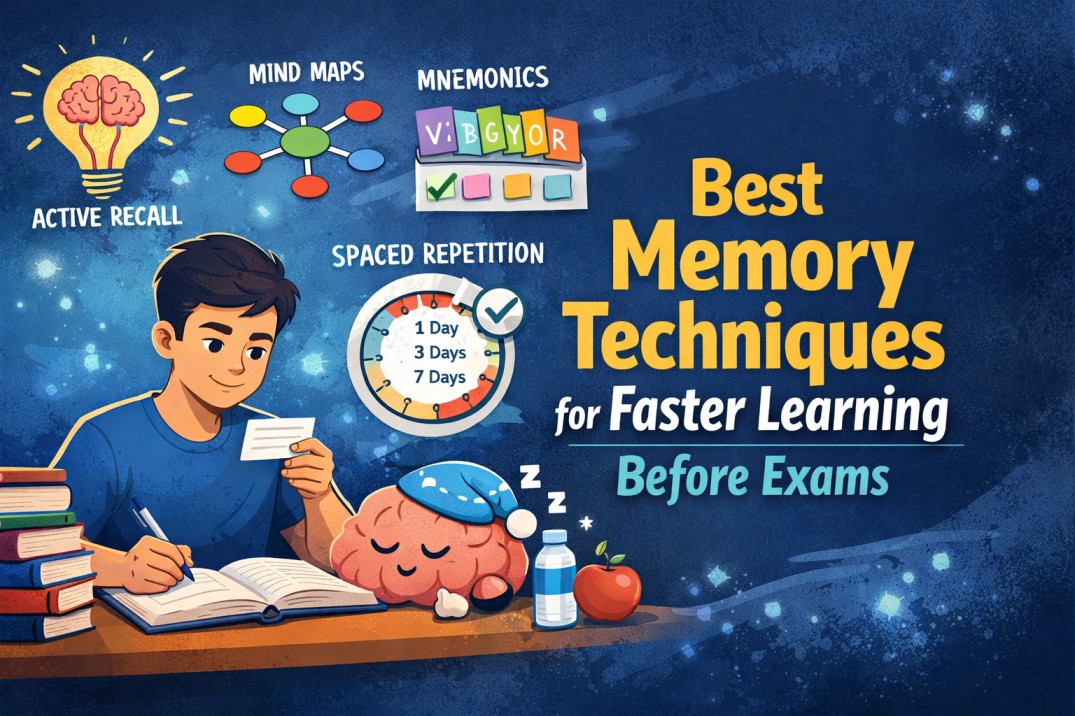
Exams require more than just effort; they require more effective means of studying. It’s common for students to spend countless hours poring over books only to find they cannot answer questions during exams. This is indicative of sub-optimal study techniques being utilized. Knowing how to study properly, students can learn concepts quickly, retain them for longer periods of time, and answer exam questions with a sense of assuredness. This blog post details techniques to enhance memory and learn effectively.
The Importance of Memory Skills for Exams
During exam prep, students commonly face issues such as:
Effective memory techniques allow students to retain information for longer periods of time and retrieve that information quickly and with greater efficiency. This means enhanced performance by alleviating exam stress.
Write down everything you can remember about a topic after you finish studying
Why it works: Higher levels of information retention are achieved through the use of active recall as opposed to passive study methods.
Rather than cramming information in a set amount of time, spaced repetition is the technique that suggests that information should be reviewed after set intervals of time.
An easy-to-follow spaced repetition plan is as follows:
Day 1: Learn the topic.
Day 3: Revise what you learned.
Day 7: Revise again.
Day 15: Conduct a quick review.
Explanation: Information tends to be stored in the long-term memory if the topic is revisited just before you forget it.
Using keywords, colors, and branches, mind maps visually organize information.
Using mind maps is easy.
Write the main topic in the center.
For subtopics, add branches.
Use colors, symbols, and short phrases.
Explanation: Visual learning helps comprehension and makes exam prep faster, and mind maps help you learn visually.
Favorites, lists, and sequences can be remembered using sentences or acronyms.
Examples:
The colors of the rainbow: VIBGYOR.
Points can be remembered using a meaningful or funny sentence.
Explanation: Better memory recall comes with varying styles, and the brain remembers patterns and stories more easily than dry, plain facts.
To enhance memory, explaining concepts to others works well.
You can implement this method in the following ways:
Teach a friend or sibling.
Distinctly explain the content as if you are addressing a full class.
Identify areas you are weak at, and revise them.
Explanation: Teaching improves recall and deep understanding.
Copying content from the textbook is unacceptable.
Effective Notes
List everything in a bullet-point format.
Column your key terms and formulas and highlight them.
Use language that is basic and clear.
Reason: If you write it in your own words, it clears your mind and you will remember it better for the exam.
Focused Study Sessions
Studying for hours on end is a recipe for ineffective learning.
Study for 25 minutes.
Take a 5-minute break,
After four sessions, take a longer break, and repeat.
Reason: Memory and focus enhance during learning when the session is only lightly prolonged.
Nutrition and Sleep
Memory is only improved with a properly functioning brain.
Sleep for 7-8 hours.
Consume healthy meals, nuts, and fruits.
Drink water often.
Reason: Memory is crisp and clear when consolidated in sleep.
Conclusion
It is clear that in order to score in the exams, learning needs to take place and not studying for a long duration. Learning is improved and retained through the use of active recall, spaced repetition, mind mapping, and mnemonics. Once these techniques are used with shorter breaks, better sleep, regular advancing through the material and revision, CBSE Board Exam 2026 performance will also improve.
Exam Preparation Memory Techniques: FAQs
1. What is the best memory technique for students?
In terms of exam performance and long-term memory recall, Active recall is the best and most effective technique when it comes to improving memory.
2. How can students remember what they study faster?
Students’ faster memorization can involve spaced repetition, short notes, and self-testing the material at regular intervals.
3. Does lack of sleep affect memory?
Yes, memory and info retention get worse if someone does not get enough sleep prior to studying or taking a test.
4. How many hours should students study daily?
Students should work for 2-4 hours a day because use of smart study techniques is way better than long, tiresome sessions.